
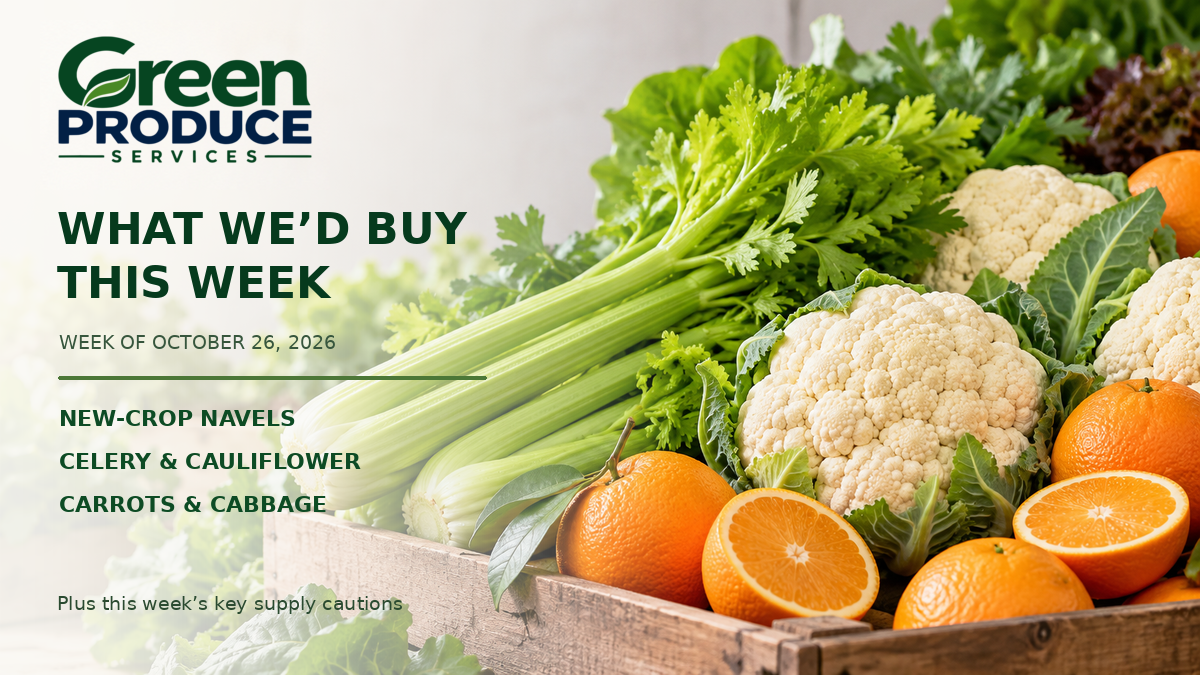
California’s late-October rain has sharpened the divide between stable fall staples and high-risk fresh items. For Southern California restaurant and commercial-kitchen buyers this week, the stronger purchasing opportunities are new-crop Navel oranges, celery, cauliflower, carrots and cabbage. The items requiring the closest order control are strawberries, lettuce, tomatoes, green beans and cilantro.
This is an industry-market briefing, not a claim about Green Produce Services’ live inventory or delivered prices. Always compare the actual size, grade, pack, usable yield and delivery date before changing an order.
What We’d Buy This Week
- New-crop California Navel oranges: California Navel harvest volume is building as the Valencia season wraps up. Smaller 113- and 138-count fruit is becoming easier to source, according to Markon. Ask for an equivalent delivered quote by count and grade if you serve individual fruit portions, school snacks or catered breakfasts; a different count changes portions per case.
- Celery: Current market reporting describes steady availability and generally good quality from Salinas and Santa Maria, with flexibility across sizes. It is worth price-checking for stocks, mirepoix and prep-heavy kitchens. Specify stalk size or trimmed yield; a lower case price may create more labor if it does not fit your prep.
- Cauliflower: Additional fields have improved availability and helped soften the market, although insect pressure still affects some California areas. Compare carton/head count and trimming yield for roast vegetables, soups and purees rather than simply comparing cases.
- Carrots: Current crop reports indicate steady supplies and good sizing across common packs. A practical staple for schools, senior living kitchens and high-volume prep. Compare loose carrots against peeled or cut products using usable weight and prep time.
- Green or red cabbage: Market reports indicate generally steady conditions and good quality. Consider it for slaw, braises, fillings and cooked side dishes when the recipe supports it. It is not an interchangeable substitute for iceberg in a crisp lettuce salad.
What Deserves Caution
Strawberries: shortages and short shelf life
Markon’s October 26 field report describes water damage after recent Central Coast rainfall. California growers expected to cover only about half of the orders packing early this week, with additional harvest cancellations, low volumes and shortened shelf life possible. Do not rely on last week’s strawberry quantity, price or quality holding steady. For fruit cups and breakfast service, ask whether suitable oranges or other fruit can cover part of the need; do not substitute in a strawberry-specific recipe without kitchen approval.
Iceberg and romaine: focus on carton weight and usable leaves
Industry reports continue to flag INSV disease pressure and lighter yields in Salinas and Santa Maria. Early Huron production may help, but it is not enough to assume an across-the-board reset. Ask for the actual origin, pack weight and quality specification; shorter ordering cycles may reduce wilt and trimming loss. A lower quoted case price does not necessarily mean a lower usable-portion cost.
Tomatoes and green beans: verify the exact specification
Tomato supplies remain limited as California winds down and Mexican and Eastern growing areas transition. Confirm round versus Roma versus grape tomatoes, ripeness stage and count before accepting a substitute. Separately, Markon’s October 26 green-bean update reports that West Coast production ended early after rain, Baja output remains constrained, and relief may not arrive until mid-November. If fresh beans are essential for a menu, confirm the fill rate early; frozen beans may be a recipe-specific alternative for cooked preparations only.
Cilantro and avocados: quality and timing risks
Cilantro supplies are generally meeting demand, but Markon reports more variable quality, yellowing, bolting and reduced shelf life after warm weather and rain. Order to expected use rather than excess backup. Markon also reported isolated avocado harvesting interruptions in Mexico on October 26. Current fruit in transit provides some coverage, but buyers requiring a fixed ripeness stage should confirm the delivery window and an acceptable size/count instead of assuming future market stability.
Simple Decisions for This Week’s Produce Order
- Price flexible items separately: request quotes for Navel orange counts, cauliflower head sizes, celery packs, carrots and cabbage using equivalent usable yields.
- Shorten high-risk turns: order strawberries and vulnerable greens closer to service, with receiving checks for wet fruit, decay, discoloration and low case weights.
- Get substitutions in writing: specify what menu application and preparation method allow a change; never assume apples, citrus, frozen beans or cabbage are universal stand-ins.
- Confirm deliveries and fill rates: supply reports do not establish any individual distributor’s live availability or delivered price.
Green Produce Services supplies wholesale produce to restaurants and commercial kitchens across its Southern California service area. If you have a current purchase list, request a delivered produce quote with the counts, packs and kitchen uses that matter. For help comparing bids, see our wholesale pricing guide and our market updates archive.
Sources and Dates
- Markon, Strawberry Update — October 26, 2026.
- Markon, Green Bean Update, Cilantro Update, and Avocado Update — October 26, 2026.
- PRO*ACT crop update, via The Produce News — October 21, 2026.
- Primo Produce, Market Report — October 23, 2026.
- Markon, Citrus Update — October 15, 2026; trend checked against newer weekly market reporting.
- ProduceIQ via Blue Book — October 26, 2026, index and market context.
Prepared October 27, 2026 for the week of October 26. Commodity conditions can change daily. Industry sources are not Green Produce Services delivered-price or stock confirmations.